
FALL 2026 NEWSLETTER

VAFAW Helps Advance Two USAHA Resolutions
In October, VAFAW leaders Drs. Gwendy Reyes-Illg, Ellen Carlin, and Abby Zoltick attended the United States Animal Health Association’s (USAHA) annual meeting in Madison, Wisconsin. Founded in 1897, USAHA is a nonprofit national forum on animal health. USAHA annually advances resolutions urging government action on members’ concerns. VAFAW leaders and members worked with other USAHA members to draft three resolutions; two were adopted. The first urges the U.S. Department of Agriculture (USDA) to issue a targeted federal highly pathogenic avian influenza (HPAI) poultry vaccination strategy to prevent the annual depopulation of tens of millions of chickens, turkeys, and ducks. The second calls for progress in trade negotiations, which are essential to advancing any HPAI vaccination strategy. At the meeting, VAFAW also began recruiting members for an informal, cross-sector coalition to advance targeted vaccination of U.S. poultry against HPAI. The third resolution aimed to prioritize higher-welfare methods of depopulation over ventilation shutdown (VSD) and VSD plus heat (VSD+) in federal indemnity policy, noting the documented psychological distress among veterinarians involved in the process. Although this resolution failed, discussion underscored the need to accelerate the shift to higher-welfare depopulation. USDA Veterinary Services, which oversees HPAI-related depopulation, urged states and industry to use newly increased National Animal Disease Preparedness and Response Program funding for this purpose. At the meeting, Dr. Abby Zoltick, VAFAW’s Director of Education, presented data on the physical and psychological harms of sow intensive confinement. She emphasized supporting the transition to and management of group housing systems, which enable sows to perform behaviors critical to their health and welfare. VAFAW also had an exhibit booth at the event, which provided a great opportunity to connect with producers, industry representatives, researchers, and veterinarians in regulatory medicine, animal production, international trade, and public health.
Read the approved USAHA resolutions.
Read the veterinarian-focused study on psychological distress caused by depopulation and proposed policy approaches.
To get more information about the informal coalition VAFAW is organizing to advance a federal HPAI poultry vaccination strategy, complete the expression of interest form.


Dr. Abby Zoltick, Director of Education, at the VAFAW exhibit booth and presenting about sow welfare.
WEBINAR SERIES
SAVE THE DATE! Five Domains Webinar (February 17, 2027)
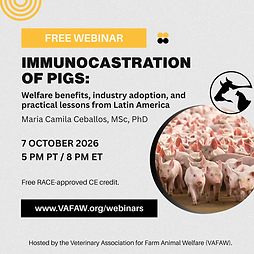
Recap: Immunocastration of Pigs: Welfare Benefits, Industry Adoption, and Practical Lessons from Latin America (October 7, 2026)
In the U.S., nearly all male pigs are surgically castrated without anesthesia or any form of pain relief. However, immunocastration is gaining recognition as an effective alternative, offering important animal welfare benefits while maintaining performance. In a VAFAW-hosted webinar on October 7, Dr. Maria Camila Ceballos discussed the science behind immunocastration, its welfare and production advantages, and the challenges to broader adoption. Drawing on recent research and insights from producers and industry leaders in Brazil and Colombia—countries with high adoption rates—the presentation highlighted the motivations, benefits, and barriers shaping implementation and identified opportunities to expand immunocastration in commercial swine production.
Join us on February 17, 2027 for a VAFAW-hosted webinar presented by Dr. Kat Littlewood on the Five Domains Model, a framework for assessing animal welfare. Dr. Littlewood is a registered veterinary specialist in animal welfare, ethics and law. She is internationally recognized for her work on the Five Domains Model for animal welfare assessment, including co-authoring the 2020 update and the Five Domains Model chapter in Mental Health and Well-being in Animals with Emeritus Professor David Mellor and colleagues. Stay tuned for an announcement with more details.
VAFAW ADVOCACY: SEEKING CHANGE
Read VAFAW’s survey responses
Read VAFAW’s comment letter
Since nearly every dairy farm in the U.S. participates in the National Dairy Farmers Assuring Responsible Management (FARM) Program, the standards in FARM’s Animal Care Program significantly impact dairy cattle and calf welfare. Several revisions to the standards have been proposed for the 2028 edition, and FARM asked stakeholders—including veterinarians, farmers, researchers, and consumers—to share comments, feedback, and concerns via a survey. In addition to encouraging members to participate in the FARM survey, VAFAW submitted its own survey responses and a separate comment letter. In its comments, VAFAW recommended enforcement of each standard described as “required.” We also recommended that those tasked with revising the standards be permitted to suggest revisions to any areas where they are called for, rather than assessing only predetermined sections of the program standards. In response to survey questions, VAFAW recommended against weakening standards related to tail injuries and suggested requiring Herd Health Plans to include a written protocol for tail injury prevention and treatment. We supported the proposal to make fitness-for-transport standards more specific, while recommending additional requirements to safeguard neonatal calves and cattle with painful health conditions. VAFAW also recommended aligning pain-control requirements for management procedures with veterinary guidelines released since the previous edition and prohibiting hot-iron and freeze branding unless required by law. Since FARM had proposed revisions focused on calf feeding practices, VAFAW recommended incorporating measures necessary for a successful transition toward social housing of calves.
VAFAW Urges Strengthening of Dairy Industry Welfare Standards
Farm Bill Threatens Farm Animal Welfare Protections. You Can Help.
The Farm Bill is moving through Congress, and it could set back significant advancements in farm animal welfare. The House-passed bill includes Section 12006, a provision similar to the Save Our Bacon Act, that would undo state laws protecting farm animals from extreme confinement. These include California’s Proposition 12 and Massachusetts’ Question 3, which prohibit pregnant pigs from being confined for months in gestation crates, stalls so small that they cannot turn around. The Senate’s version of the bill does not include this provision. Research has consistently shown that confining pregnant pigs in gestation crates for months causes significant physical harm and psychological distress. VAFAW is working to ensure these critical protections are not undone as Congress reconciles the two bills. You can help. If you live in the United States, use VAFAW’s advocacy platform to urge your members of Congress to protect Proposition 12. Even if you’ve already sent a message, please reach out again. Continued engagement helps keep farm animal welfare protections top of mind as negotiations move forward.
Send a message to your members of Congress.
Additional information is at www.VAFAW.org/sowsneedspace.

U.S. Comments to WOAH Reflect VAFAW Input on Depopulation
As mentioned in previous newsletters, the World Organisation for Animal Health (WOAH) is revising Chapter 7.6 of the Terrestrial Animal Health Standards Code (TAHSC), Animal Welfare at the Time of Killing for Purposes Other Than Slaughter. In June, VAFAW provided detailed technical comments to the USDA to inform comments submitted on the draft chapter by the United States. The U.S. has now posted its comments to WOAH, and VAFAW was pleased to see the U.S. recommending the inclusion of additional content related to nitrogen whole house gassing, a higher-welfare depopulation method for poultry. The U.S. cited a 2025 VAFAW webinar on the topic presented by board member Jeff Hill. VAFAW’s recommendation regarding restricting the use of electric goads was also included in the comments submitted by the U.S. Unfortunately, despite VAFAW recommendations to the contrary, the U.S. continues to advocate for the reinsertion of two depopulation methods that had been slated for deletion by WOAH due to their inherent negative animal welfare impacts: ventilation shutdown with supplementation, which kills via heatstroke, and water-based foam, which kills via airway occlusion. We anticipate that WOAH will either provide one additional comment cycle or propose the chapter for adoption at the May 2027 WOAH General Session.
U.S. comments on Chapter 7.6 Animal Welfare at the Time of Killing for Purposes Other Than Slaughter of the WOAH TAHSC.
VAFAW comments to the USDA recommending changes to the WOAH Ch. 7.6 Animal Welfare at the Time of Killing for Purposes Other Than Slaughter. (Context document)
VAFAW webinar recording and PowerPoint on nitrogen-based depopulation methods cited by the United States in its comments.
WHAT CAUGHT OUR EYE
Converting Sow Gestation Crates to Group Housing: Short-Term Costs and Long-Term Benefits
Jim Eadie, Swine Web
A multi-year study conducted by the Prairie Swine Centre (an applied swine research center affiliated with the University of Saskatchewan), in collaboration with the University of Manitoba and the Quebec Swine Development Centre, examined the cost to Canadian pork producers of converting barns from gestation crate housing for sows to group housing. The researchers found that conversion costs averaged $250–$500 per sow space, depending on the size and design of the operation. This cost was at least partially offset by efficiency gains observed soon after the transition.

Read the original sow housing conversion report.
Watch a replay of the VAFAW-hosted webinar Essential Elements for Successful Group Housing of Sows with Dr. Jeremy Marchant.
Océane Amichaud et al., Scientific Reports
Continuing our trend of sharing new research in cow studies, this study by Amichaud et al. examines bovine responses to human emotional expressions and subsequent interactions. Researchers monitored cows’ eye movements, duration of engagement, and physical movements (stepping backward or forward) as the cows watched 30-second videos of humans expressing anger or joy. Cows spent more time looking at videos depicting anger but, when later given a choice, spent more time near the experimenter they had previously seen expressing joy. Understanding how cows perceive humans and use emotional cues can inform handling practices that give them greater choice and control, improving welfare and human–animal relationships.
Animal Transport: Congress Should Consider Modernizing the Law to Better Protect Livestock
Study by U. S. Government Accountability Office
The Twenty-Eight Hour Law is federal legislation intended to protect livestock welfare during transport by mandating breaks for food, water, and rest after 28 hours of consecutive travel. A recent study by the U.S. Government Accountability Office (GAO) evaluating the law resulted in three recommendations: (1) the amendment or passage of new laws to account for welfare issues that arise beyond travel duration such as extreme temperatures, fitness to travel, driver preparedness, and equipment safety and sanitation; (2) federal agencies be given authorization to monitor livestock transport; and (3) current penalties be strengthened and agency action enforcement be permitted.
A QUESTION FOR YOU
Finding this newsletter useful? Raising awareness and educating others about issues affecting farm animal welfare is central to our mission. Each issue takes considerable time to research and compile, and we offer it free to everyone. Your tax-deductible donation makes that possible.
A STEP IN THE RIGHT DIRECTION
As the world’s sixth-largest pork producer, Denmark has some concentrated animal feeding operations that can accommodate up to 25,000 pigs. In June, the Danish people addressed concerns over the effects of ultra-intensive farming on both animals and the environment by re-electing a prime minister who promised reform. Collaborating with four other organizations, Animal Protection Denmark began what they dubbed “Alliance for a Pig Election.” Leveraging journalism and television documentaries, the alliance sought to increase public awareness. Additionally, a citizens’ initiative with 50,000 required signatures triggered a parliamentary debate, bringing the issue into the political spotlight. For reference, the top-producing 10% of Danish operations raise sows that each wean about 43 piglets per year—much higher than in the Netherlands, another intensive pork producer, whose sows wean about 31 piglets annually. Campaigners highlighted extreme breeding, which increases litter size beyond sow nursing capacity, as a major cause of Denmark’s mortality rate of approximately 9 million piglets each year. As a result of the campaign, the elected government introduced a new program that offers considerable welfare improvements for pigs, including a ban on routine tail docking and extreme breeding, as well as more mandated space to move for sows and piglets. Denmark will also remove their agricultural commissioner, shifting to a minister for nature and animal welfare, with a special commission appointed to restructure the agricultural sector’s portfolio.
Global Progress on Vaccination Against HPAI
As the number of domestic birds depopulated in the United States during the current highly pathogenic avian influenza (HPAI) outbreak approaches 210 million, progress is being made globally on vaccinating poultry against the disease. Vaccination of chickens against HPAI H5 is already practiced in several Latin American countries, particularly for layers and breeders. France, which has been vaccinating ducks on farms since 2023, continues to document the positive impact of its vaccination program. The Dutch government is developing a strategy to make HPAI vaccination compulsory for all hens raised for egg production, while Denmark and Japan are considering similar proposals for certain sectors of their poultry industries. The United Kingdom and Canada both recently started HPAI poultry vaccination trials, and South Africa has established a legal framework to enable the controlled use of HPAI vaccines. At present, the United States, like Australia and New Zealand, only provides HPAI vaccination on a rare basis to endangered native birds. While egg, turkey, and dairy industry trade groups have urged progress on a national HPAI vaccination strategy, resistance has come from the broiler sector, citing concerns about potential impacts on exports. However, the USA Poultry and Egg Export Council (USAPEEC) recently approved a motion requesting USDA's Animal and Plant Health Inspection Service (APHIS) engage in formal consultations with trading partners regarding the trade implications of potential vaccination. The World Organization for Animal Health is developing non-binding standards for the surveillance of vaccinated flocks, which should also help address trade-related concerns.

Review a recent presentation by an HPAI expert on global progress toward acceptance of poultry vaccination against HPAI.
Read related updates from presentations at the World Egg Organization’s recent meeting.
Read more about Canada’s HPAI vaccination trials for layer and turkey flocks.
The AVMA's Animal Welfare Division has published a new literature review on the care of dairy calves not destined to be replacement animals in milk-producing enterprises (i.e., calves for veal or dairy-beef production). With 190 references, the document contains individual sections dealing with: transportation (duration, age at transport, commingling and stocking density, food and water deprivation, seasonality, immune status and fitness to travel), housing (cow-calf vs. individual vs. paired or group), nutrition (colostrum, milk and milk replacers, solids), health (respiratory disease, diarrhea, umbilical infections) and the behavioral enrichment of non-replacement dairy calves. As such, the report represents a comprehensive review of what is currently known about the care of this particular class of agricultural animals.

ACHIEVING SUSTAINABILITY
VAFAW Receives Grants from the Parks Foundation
VAFAW is pleased to announce that we have received grant funding from the William and Charlotte Parks Foundation for Animal Welfare to advance our work toward ensuring an expeditious and humane end of life when farm animals are depopulated. VAFAW received a grant from the same funder last year for our work on the upcoming guidebook on preventing and mitigating pain associated with painful management procedures. This demonstrates confidence in VAFAW’s ability to advance meaningful improvements in farm animal welfare. We are grateful for the support.

SPOTLIGHT ON VAFAW LEADERS
Welcoming Our New Treasurer, Dan McQueen
We are thrilled to announce that Dan McQueen has officially joined our leadership team as VAFAW’s new treasurer. Dan is a finance, sales, and strategy professional who is passionate about animal welfare and improving the current systems surrounding farm animals. He earned a Bachelor of Science in Finance from Bentley University in 2013, and a Master of Business Administration from Boston University Questrom School of Business in 2019. In his professional career, he has helped analyze and improve the financial position of companies of various sizes—from a local family retail store to a billion-dollar distribution company. Dan has particular expertise in budgeting and financial statement analysis, along with a strategic mindset for long-term organizational development, shaped by a Strategy & Innovation concentration in his Master of Business Administration program. Dan currently lives in Southern New Hampshire with his partner, Rebecca, and their dog, Angus. He enjoys spending time with his family, woodworking, golfing, and learning about nature conservation and history.

Our Leaders Publish and Present to Advance the Field
Dr. Abby Zoltick, VAFAW Board Member and Director of Education, recently co-authored an innovative paper titled “Leveraging Dairy Cattle Dietary Preference for Pasture Diversification to Optimize Marginal Land Recruitment into Agroecosystems.” The article explores whether dairy farmers could use cows’ natural preferences for different plants to help design more diverse pastures, particularly on land that isn’t well suited for growing crops. The authors suggest that understanding what cows choose to eat—and how those choices change with the season and other conditions—could help create pastures that support cattle while also improving biodiversity, soil health, and other environmental benefits.
Dr. Eduarda Bortoluzzi, VAFAW Board Member, and her colleague Dr. Johann Coetzee recently published “Current Trends and New Developments in Assessing and Managing Pain in Cattle” in Veterinary Clinics: Food Animal Practice. The paper reviews current barriers to effectively managing pain in cattle and emphasizes the role of veterinarians in improving practices. Recent developments in cattle pain assessment are reviewed. The paper highlights the role of multimodal analgesia in improving animal welfare and enhancing production outcomes, and provides a table comparing the half-life and withholding period of various NSAIDs.
VAFAW Leaders Present at Africa Animal Welfare Conference
On October 6, VAFAW’s President, Dr. Gwendolen Reyes-Illg, and Board Member, Mr. Jeff Hill, presented virtually about poultry depopulation at the 10th annual Africa Animal Welfare Conference in Lusaka, Zambia. They joined representatives from the Animal Welfare Institute, Humane World for Animals, and the Zambian Ministry of Fisheries and Livestock to discuss concerns and potential solutions regarding poultry depopulation. The Food and Agriculture Organization of the United Nations estimates that by 2050, sub-Saharan Africa will have more poultry than any other region of the world, and many of these animals will reside in industrial concentrated animal feeding operations (CAFOs). Dr. Reyes-Illg described the widespread adoption of the heatstroke-based depopulation method ventilation shutdown plus heat (VSD+) in the United States and urged delegates to consider preemptive action to prevent a similar occurrence in African countries. Mr. Hill presented on nitrogen-based depopulation methods, including how they might be incorporated into barn construction. Following the presentation, attendees discussed means of reducing costs through advanced preparedness. One outcome of the conference was the adoption of a resolution urging African Union Member States to adopt policies to discourage the use of heatstroke-based depopulation methods and to promote higher-welfare depopulation methods, such as nitrogen-based methods.

PHILOSOPHER'S CORNER
Animal Emotions and Philosophy
By Kate Brelje, MA, PhD, VAFAW Philosopher In Residence
Emotions are a central part of our lives. As the Stanford Encyclopedia of Philosophy article on emotions begins: "No aspect of our mental life is more important to the quality and meaning of our existence than the emotions." How important emotions must be for animal welfare as well! Philosophers differ on theories of emotion, but the emotions themselves are terms readily applied to animals, such as fear, panic, enjoyment, and surprise. Other emotions are more controversial when applied to some animals, for example grief. There are studies that claim that animals such as killer whales and elephants mourn their dead. The controversy in philosophy concerns whether this is a useful form of anthropomorphism: taking a human experience or attribute and applying it to a non-human being. Some cases of anthropomorphism might be beneficial. For example, at a time when some philosophers believed that animals did not experience pain, projecting the known human ability to suffer onto animals might actually have brought them closer to the truth. Now we know that animals can suffer. Navigating the line between what animals are capable of experiencing and what we can infer from their behavior makes a great difference to the scientific investigations we conduct into better understanding animal emotions. Animal emotions also constitute welfare for an individual or species. Mental states, emotions, and affect play a huge role in the Five Domains and are reflected in VAFAW's animal welfare statement. If we admit that animals have emotions and identify which ones they have, that radically changes how we can interpret their experiences and support their quality of life.
Read VAFAW's animal welfare statement.
Stay In The Know
Support Our Free Educational Content
VAFAW utilizes AI tools to assist in creating content for this newsletter, which is always reviewed by our editorial team for accuracy, clarity, and responsible presentation.
Businesses named in articles are for informational purposes only and should not be viewed as endorsements.