
SUMMER 2026 NEWSLETTER

Farm Animal Welfare Protections Under Attack, VAFAW Takes Message to Congress
State laws that protect farm animals from extreme confinement are under attack by Congress, and VAFAW has deployed a multipronged advocacy strategy to ensure these laws stay in place. A provision in the 2026 Farm Bill passed by the U.S. House will preempt—or undo—state laws, like Proposition 12 and Question 3, that encourage higher-welfare production practices. These state laws, passed overwhelmingly by voters, prohibit pregnant pigs from being confined for months in gestation crates, stalls so small that they cannot turn around. Next, the U.S. Senate will consider its own version of the Farm Bill, and its initial draft does not include the same language. VAFAW is working to ensure a preemption provision is not added in later by amendment. The American Veterinary Medical Association has repeatedly supported overturning Prop.12; led by current animal welfare science, VAFAW offers a different veterinary perspective.
Learn more about this issue by watching a recent webinar by VAFAW leaders and visiting www.VAFAW.org/sowsneedspace.
Read the AVMA May 2024 and April 2026 letters endorsing federal preemption of state animal welfare laws.

How can you help?
-
If you live in the United States, use the VAFAW advocacy platform to send messages directly to your members of Congress.
-
Raise awareness about this issue by posting on social media and writing letters to the editor. Be sure to tag your members of Congress.
-
If you are an AVMA member, reach out to your delegate and district director and ask the AVMA to withdraw its support of Prop. 12 preemption.
For additional perspectives on this issue, read essays by Nicholas Kristof (What the Meat Industry Doesn’t Want You to Know) and Ezra Klein (What the Cult of Efficiency Costs Us) recently published by The New York Times.
WEBINAR SERIES
SAVE THE DATE! Immunocastration of Pigs: Welfare Benefits, Industry Adoption, and Practical Lessons from Latin America | Wednesday, October 7, 2026
Castration is one of the most common painful procedures performed in livestock production, impacting hundreds of millions of farm animals worldwide each year. In the U.S., nearly all male pigs are castrated without anesthesia or analgesia. This fall, VAFAW will host a webinar, “Immunocastration of pigs: welfare benefits, industry adoption, and practical lessons from Latin America,” presented by Dr. Maria Camila Ceballos, Associate Professor of Animal Welfare and Behavior at the University of Calgary Faculty of Veterinary Medicine. She will cover the welfare and production considerations of this higher-welfare alternative to surgical castration that uses a vaccine to temporarily suppress reproductive hormone production. Drawing on recent research conducted in Brazil and Colombia — among the countries with the highest adoption rates worldwide — the presentation will explore the motivations and challenges influencing on-farm implementation of immunocastration. This webinar is intended for participants across the pork supply chain, including retailers, veterinarians, producers, and animal health professionals. Watch for additional details and registration information in September, and plan to join us for this important webinar.
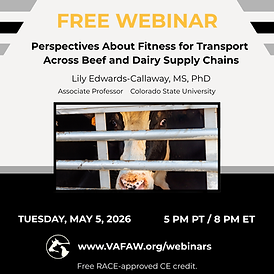
Recap: Perspectives About Fitness for Transport Across Beef and Dairy Supply Chains (May 5, 2026)
Fit for transport, or not? In the U.S., farm animals are often transported over long distances at times when they are especially vulnerable, for example, soon after birth or when they are slated for culling. In a VAFAW-hosted webinar on May 5, Dr. Lily Edwards-Callaway from Colorado State University discussed how fitness for transport is defined in the beef and dairy industries, the challenges across the supply chain, and how veterinarians, producers, and plant employees navigate these complex decisions.
Since the webinar, there has been a notable development — In June, the U.S. Government Accountability Office issued a report recommending that Congress amend the Twenty-Eight-Hour Law to address issues such as fitness for transport.
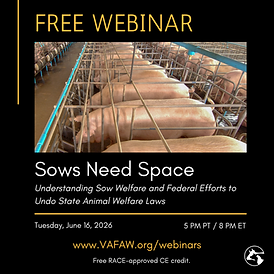
Recap: Sows Need Space: Understanding Sow Welfare and Federal Efforts to Undo State Animal Welfare Laws (June 16, 2026)
State-level laws that protect farm animals from extreme confinement, like Proposition 12 and Question 3, are at high risk of being undone by Congress. Research has consistently shown that these systems, such as gestation crates for pregnant pigs, cause significant physical harm and psychological distress. On June 16, VAFAW veterinarians and policy experts discussed these state laws, the animal welfare science that supports them, and how advocates can help ensure they stay in place.
CONFERENCES & MEETINGS
VAFAW Attends the Dairy Cattle Welfare Council Symposium
This May, VAFAW attended the Dairy Cattle Welfare Council (DCWC) Symposium as a Bronze Sponsor. The three-day conference brought together researchers and industry professionals to discuss topics including cow-calf contact, end-of-life decision making, and strategies for promoting positive dairy cattle welfare. The conference concluded with a day of Spanish-language sessions focused on employee culture, herd health management, compassion fatigue, and welfare considerations for both cattle and their caretakers. During the symposium, attendees participated in welfare-focused workshops and collaborative brainstorming sessions. One of the highlights for VAFAW was a producer panel featuring dairy farmers who have successfully transitioned to social calf-rearing systems. Panelists shared their experiences and insights, providing valuable perspectives on the practical implementation of higher-welfare housing for dairy calves. VAFAW Director of Education, Abby Zoltick, presented a poster on dairy cattle dietary preferences. Her research examines how pasture diversification can support marginal land restoration and improve cattle welfare by providing a greater diversity of forage options. Abby was newly elected to the DCWC Programs Committee and looks forward to helping shape and support next year’s symposium.
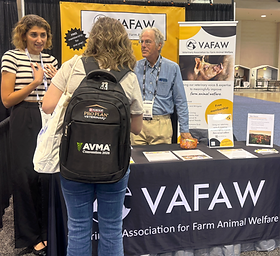
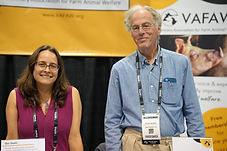
Elevating Farm Animal Welfare at the 2026 AVMA Convention in California
VAFAW traveled to Anaheim, California, in July for the 2026 American Veterinary Medical Association (AVMA) Convention. This was the third time VAFAW has hosted a booth at the event, and it's always a great way to connect with new and existing members committed to advancing farm animal welfare. Gwendy Reyes-Illg (President & Co-Executive Director), Barry Kipperman (Board Member), Claire Witting (Volunteer), and Alanna Klein (Volunteer) shared details about our mission and programmatic work with attendees in the exhibit hall. Thank you to those who stopped by to learn more about our activities and express enthusiasm for the organization. More than 65 people joined VAFAW as new members!
VAFAW Board Member Highlights Nitrogen Whole House Gassing as a New Approach to Poultry Depopulation in the U.S. at ISAMM
Jeff Hill, President of Livestock Welfare Strategies and a VAFAW board member, presented on June 30, 2026, at the 8th International Symposium on Animal Mortality Management (ISAMM) in Stevens Point, Wisconsin. The presentation outlined worldwide efforts to research and develop nitrogen-based methods for the depopulation of poultry, highlighting preliminary research results from a collaborative project with the Minnesota Department of Agriculture. Funding for this project was provided through the National Animal Disease Preparedness and Response Program to further validate, optimize, and demonstrate nitrogen whole house gassing (NWHG) for Minnesota’s poultry industries, thereby bringing a new method of poultry depopulation to the U.S. This project evaluated the impact of NWHG on barn environmental conditions, bird behavior through visible and thermal video imaging, and physiological impacts using implantable Star-Oddi dataloggers, with veterinarians performing sensor implantation and contributing to the evaluation of all study data and outcomes throughout the process. In addition, it has provided insights into liquid nitrogen availability, logistical requirements, and associated costing. This effort has demonstrated that NWHG is an efficient, cost-effective, and humane option for the mass depopulation of poultry.
VAFAW Connects with Welfare-Minded Veterinarians Internationally
In March, the Canadian Veterinary Medical Association Animal Welfare Committee (AWC) invited VAFAW to share updates about our work at its annual meeting. Drs. Gwendolen Reyes-Illg and Abigale Zoltick presented virtually about VAFAW’s educational and advocacy efforts since our last meeting with the full committee a year ago. We continue to communicate with individual AWC members throughout the year to find opportunities for mutual learning and collaboration.
WHAT CAUGHT OUR EYE
Assessment of Lasting Pain Following Castration in 2-Week-Old Calves
Seonpil Yoo, Marina A.G. von Keyserlingk, and Daniel M. Weary, Animal
This study provided evidence that the number of short-duration lying bouts is a useful metric for post-castration pain in 2-week-old dairy calves. Half the calves were surgically castrated, and half were banded. Pain control entailed the use of xylazine, local anesthesia, and an NSAID at the time of castration, with some calves receiving supplementary meloxicam. An increased number of short-duration lying bouts in the days after castration raised questions about the adequacy of the pain management techniques employed at fully suppressing post-castration pain. Band-castrated calves exhibited more signs of ongoing pain than surgically castrated calves.

How Barren Environments Amplify Pain in Captive Animals
Summary by Meghann Cant, Faunalytics
This article summarizes a recently published study showing that barren, confined environments not only fail to relieve pain in farm animals — they amplify it. By restricting mobility, social interaction, exploration, and rest, confinement systems disable natural pain-suppression mechanisms and increase stress, inflammation, and pain sensitivity, thereby prolonging suffering and slowing recovery.
United States Poultry Flocks Remain Unvaccinated Against H5 Influenza—But Why?
Michelle Kromm et al., Journal of the American Veterinary Medical Association
Seemingly insurmountable obstacles have blocked vaccination of U.S. poultry flocks for H5 influenza, but the authors destigmatize each obstacle and explain solutions. A fit-for-purpose vaccine already exists; the established Secure Poultry Supply Plan can provide a risk-mitigation framework; and, probably most critical for trading partners, a robust and trustworthy surveillance program can be created through existing partnerships between federal and state diagnostic labs and industry. If industry economics is the only concern, this narrow viewpoint overlooks the broader consequences of recurring H5-HPAI outbreaks, including impacts on local business, resource depletion, food security, and public health. Vaccination should be reconsidered as part of a broad disease mitigation strategy.
VAFAW ADVOCACY: SEEKING CHANGE
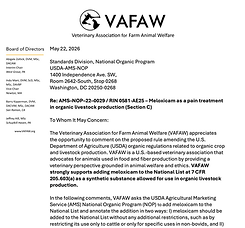
The USDA’s request for public comment on the proposed rule is available.
VAFAW submitted comments to the U.S. Department of Agriculture (USDA) advocating for the addition of meloxicam to the National List of Allowed and Prohibited Substances as a synthetic substance allowed for use as pain treatment in organic production. Pain management options on organic farms are currently limited. Our comments suggest that no restrictions, such as use only in cattle or only for specific uses in non-bovids, be included in the meloxicam listing. Based on how the Food Animal Residue Avoidance Databank (FARAD) determines recommended withdrawal intervals (WDI) for drugs used in an extra-label manner, we also advocate against the statute requiring an unnecessarily long withdrawal period for meloxicam when it is administered to organically raised animals.
VAFAW Urges USDA to Approve Meloxicam for Pain Relief on Organic Farms
VAFAW Advocates for Higher-Welfare Depopulation Practice in the U.S. and Globally
As mentioned in last summer’s newsletter, VAFAW submitted comments to the USDA in 2025 regarding proposed changes to the chapter on depopulation in the World Organization for Animal Health (WOAH) Terrestrial Animal Health Code. The recommendations in Chapter 7.6, Animal Welfare at the Time of Killing for Purposes Other Than Slaughter, provide guidance to animal health officials around the world and are adopted as policy in some countries. In the updated draft released this February, we were pleased to see that WOAH had removed two depopulation methods that are widely used in the U.S. but have severely negative animal welfare impacts. The latest draft of the chapter no longer includes ventilation shutdown plus (VSD+) or water-based foam (WBF), methods of killing that rely on heatstroke and airway obstruction, respectively. In June, VAFAW submitted comments to the USDA on the latest version of Chapter 7.6, requesting that the U.S. refrain from advocating for the reinsertion of VSD+ and WBF. We also provided science-backed recommendations for improving the accuracy of sections about higher-welfare depopulation methods, such as nitrogen whole house gassing and high-expansion nitrogen foam. On a related note, for the second year in a row, VAFAW submitted outside witness testimony to the U.S. Senate and House Appropriations Committees, calling for funding for higher-welfare, nitrogen-based depopulation methods and a report on barriers to the widespread use of these methods, rather than VSD+. To date, only the House has released its appropriations report and, fortunately, it includes much of the language recommended in VAFAW’s testimony.
View the VAFAW comments to WOAH and a context document.
View the VAFAW testimony to the U.S. Senate and House Appropriations Committees (Subcommittees on Agriculture).
View the report language from the House Agriculture Appropriations Committee (see page 42).
VAFAW Submits Comments Opposing Higher Slaughter-Line Speeds for Pigs and Poultry
This spring, VAFAW responded to a call for stakeholder comments from the Food Safety and Inspection Service (FSIS), an agency of the U.S. Department of Agriculture, on two proposed rules that would increase slaughter line speeds for pigs and poultry. The New Poultry Inspection System (NPIS) proposed rule would allow NPIS slaughter plants to increase line speeds from 140 birds per minute (bpm) to 175 bpm for young chickens and from 55 to 60 bpm for turkeys. The New Swine Inspection System (NSIS) proposed rule would do away with maximum line speeds for swine (currently 1,106 pigs per hour) in NSIS slaughter plants. VAFAW opposed both rules, arguing that these changes prioritize financial gain without considering animal welfare and, in the case of swine, undermine and weaken FSIS's enforcement of the Humane Methods of Livestock Slaughter Act. Based on both scientific evidence and the field experience of VAFAW leaders, VAFAW’s key concerns included the increased risk of aversive animal handling and ineffective stunning, as well as the severe animal welfare risks that could occur in the absence of significant retrofitting of facilities to accommodate higher line speeds. Thus, VAFAW recommended that FSIS maintain or lower the current maximum line speeds.
Opportunity to Influence Dairy Industry Welfare Standards
Approximately every three years, the National Dairy Farmers Assuring Responsible Management (FARM) Program revises its Animal Care Reference Manual. This manual outlines U.S. dairy industry standards, including those that affect the welfare of cows raised for milk production and their calves. Approximately 99% of the U.S. milk supply comes from farms that participate in the FARM Animal Care Program. Farms are periodically audited to determine their compliance with the standards. Although only a relatively low percentage of the standards described in the manual are currently enforced via required corrective actions, program requirements and recommendations significantly influence both the standard of care within the dairy industry and what individual animals experience throughout their lives. The comment period on the draft 2028 standards is open until October 2, 2026, offering veterinarians, producers, animal welfare scientists, allied professionals, and consumers the opportunity to influence dairy industry animal care standards. VAFAW will post our organizational comments on our website once they are submitted, and encourage our members to also submit comments to the Farm Program. The Board of Directors of the National Milk Producers Federation approves the final version of the standards.
Read the current edition of the Animal Care Reference Manual.
View the proposed 2028 standard updates and provide input.
Read VAFAW’s comments once they are posted.
A STEP IN THE RIGHT DIRECTION
A dairy farmer in Scotland is pioneering a new system of dairy calf management where the calves are kept with their mothers until weaning at 5–6 months of age. (In the U.S., almost all dairy calves are permanently separated from their mothers within hours of birth.) This new cow-with-calf system is applicable to pasture-based dairy farms, with cows needing to be milked only once a day. Although the calves consume about 40% of their mothers’ milk production, they grow twice as fast as traditionally reared calves. Other reputed benefits of such a system include reduced labor costs, superior welfare, reduced antibiotic use, improved herd health, better soil management, and reduced environmental impacts. Economically speaking, the system is competitive with other organic-based systems.
Additional background reading.
Read details about a documentary film that chronicles the development and implementation of the new system, now premiering at select venues around the world.

The Dutch Cabinet has developed a strategic plan for mandatory vaccination of laying hens against avian influenza. In the Netherlands, over the past nine months alone, avian influenza outbreaks have been confirmed on 51 farms, and 2.25 million birds have been culled. Wageningen Bioveterinary Research's field trials showed that vaccinated hens had lower mortality and no signs of disease, and that vaccination combined with monitoring could prevent large outbreaks. Reactions in international trade have been positive. The Netherlands formed an international group (including the U.S., Canada, France, the U.K., and the European Commission) to promote global acceptance of poultry products from vaccinated birds.
Learn about VAFAW’s efforts in the U.S. to support HPAI vaccination of poultry:
-
VAFAW leaders published an op-ed in STAT News calling on USDA Secretary Rollins to approve vaccination of poultry for highly pathogenic avian influenza (H5N1). (January 2026)
-
VAFAW wrote a letter to U.S. Senator Mike Rounds asking him to endorse the Avian Influenza Vaccination Strategy Act. (June 2025)
-
VAFAW has hosted three webinars on HPAI vaccination, including two that are available for replay.

OPPORTUNITIES
VAFAW is Seeking a Treasurer
VAFAW is looking for a treasurer to oversee its financial operations and budgeting and ensure legal and regulatory compliance. The estimated time commitment would be up to 8 hours per month, plus quarterly meetings with the board of directors. This is a volunteer, unpaid position and does not include routine bookkeeping or payment of expenses. VAFAW is seeking someone with a background in finance to help ensure the financial health of this growing organization. Nonprofit experience and passion for the mission are a plus! For more details, visit www.VAFAW.org/openrole.
Animal Advocacy Careers Offers Free Career Counseling
Are you looking to leverage your veterinary expertise to drive systemic change for farmed animals? Schedule a free 1:1 career-advising session with an expert at Animal Advocacy Careers who will provide evidence-based guidance to help you get started.
Check Out USAHA’s Job Listings
The United States Animal Health Association (USAHA) posts job openings in the animal health field for both veterinarians and other animal health experts. View current job postings.
Interested in Applied Animal Behavior Science?
The International Society for Applied Ethology (ISAE) is a great source for employment and internship opportunities in the field of applied ethology. ISAE also lists openings for graduate study fellowships. Explore current opportunities.
ACHIEVING SUSTAINABILITY
VAFAW Receives Grant Funding from Coefficient Giving and the Strategic Animal Funding Circle
VAFAW is excited to announce that it has received grant funding to advance our goals of preventing and mitigating pain experienced by farm animals and ensuring humane end-of-life practices. A two-year gift from Coefficient Giving is being used for VAFAW’s education and advocacy efforts to secure pain mitigation policies for highly painful physical alterations (such as castration, disbudding, and tail docking) and to reduce the use of these painful management procedures in farm animals. The Strategic Animal Funding Circle (SAFC) is supporting VAFAW’s policy and education efforts to reduce the use of ventilation shutdown plus heat for HPAI-related depopulations and to advance the adoption and deployment of a federal HPAI vaccination strategy for layer hens and turkeys. Both awards were made after a highly competitive and rigorous review process and demonstrate confidence in VAFAW’s ability to advance meaningful improvements in farm animal welfare. We are deeply grateful for the support of these prestigious funders.


OUR IMPACTFUL WORK
VAFAW’s First-Ever Annual Report
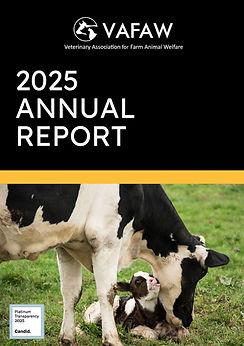
Did you miss the announcement? In April, VAFAW released its first-ever annual report. The report highlights our impactful activities in 2025, provides a look at our finances, and offers a sneak peek at our goals for the future. If you’re inspired by what you read, we hope you’ll consider donating to help expand our impact in the year ahead.
BOARD OF DIRECTORS UPDATES
VAFAW Welcomes New Board Members, Honors a Lasting Legacy
VAFAW’s Board of Directors plays a very important role by helping to advance VAFAW’s mission, guiding the strategic direction of the organization, and providing governance. We are excited to welcome three new board members, each with extensive knowledge and a strong passion for advancing farm animal welfare. Dr. Marissa Munson has worked with cattle, small ruminants, pigs, and poultry in a range of capacities, including as a clinical practitioner, an allied industry scientist, and a regulatory veterinarian. She earned her veterinary degree from Tufts University and completed a Master of Science in Animal Behavior and Welfare from the University of Pennsylvania. Dr. Mike Petrik is a poultry veterinarian for the laying hen and layer breeder industry in Canada. He also has experience treating cattle and pigs, teaching veterinary and graduate students, and working with numerous government, industry, veterinary, and animal welfare advocacy organizations. In addition to earning his veterinary degree from Ontario Veterinary College, Dr. Petrik completed a Master of Science in Animal Welfare from the University of Guelph. He grew up on a family farm, gaining practical experience in animal agriculture that continues to inform his approach to farming and animal welfare. Dr. Eduarda Bortoluzzi is currently an Assistant Professor of Animal Welfare at Kansas State University (KSU) College of Veterinary Medicine. She has extensive research experience in animal welfare, ethology, and livestock medicine, particularly in the area of pain assessment and mitigation in farm animals. Dr. Bortoluzzi received her veterinary degree from the University of Pampa, Brazil, and her master's degree and PhD from KSU. Earlier this year, Dr. Jim Reynolds retired from VAFAW’s board after several years of service. Dr. Reynolds was a founding board member who helped VAFAW grow from a small group of committed veterinarians into a successful nonprofit organization. VAFAW benefited from Dr. Reynold’s deep expertise in farm animal welfare, gleaned from his many years as a welfare consultant, dairy veterinarian, diplomate of the American College of Animal Welfare, and professor of farm animal medicine. We wish Dr. Reynolds all the best in his retirement and look forward to continuing to collaborate with him.


Marissa Munson, DVM, MSc
Mike Petrik, DVM, MSc
Eduarda Bortoluzzi, MV, MS, PhD
PHILOSOPHER'S CORNER
Representing Animal Welfare in Our Political Systems
By Kate Brelje, MA, PhD, VAFAW Philosopher In Residence
While I usually focus on ethics as VAFAW’s philosopher in residence, there are other areas of philosophy that are interesting in the context of VAFAW’s work. Political philosophy is one example, which might ask: “How are animal interests represented in our political system?” Relevant to VAFAW’s work, animal interests include having positive welfare over negative welfare. Two types of justice especially useful for VAFAW are procedural and distributive. Procedural justice is the concept of “having a seat at the table” in political processes. In our political system, we have politicians who represent our concerns in the process of making laws on local, state, and national levels. Distributive justice concerns the outcomes of the political process. Are the burdens and benefits of a law equally distributed? Or, if they are not, is there a way that people who are carrying more of the burden are compensated for that additional cost they carry for the rest of the group? For example, consider that your town is building a new landfill. How do they choose which neighborhood will bear the burden of hosting it? And will residents who experience the smell and pollution from the waste receive a tax break because of the decline in their quality of life? When we think about farm animals, we might ask, how are they represented in our political systems? And do the laws we create take into account the distribution of burdens and benefits that relate to animals? Animal cruelty laws might limit the burdens that companion animals are expected to bear for the larger society. How do or can we imagine the representation of the farm animals we work with in our political system? And as you think about it, remember — one of the frustrating and encouraging parts of philosophy is that there may not be a single, “right” answer.
Book Launch! Plant-Inclusive Care Ethics: Insights from Bonsai, Tomato Plants, and Giant Sequoia Trees
VAFAW philosopher in residence, Kate Brelje, has a new book coming out this summer: Plant-inclusive Care Ethics: Insights from Bonsai, Tomato Plants, and Giant Sequoia Trees (Routledge 2026). In addition to researching animal ethics, Kate works in environmental ethics, focusing on plants and ecosystems. In this book, she argues that humans can have ethically caring relationships with plants and interviews people working with plants (including bonsai artists, farmers, gardeners, Native caretakers, and parks department personnel) to evaluate plant care practices on the ground. Reach out to your local library or educational institution to get a copy!

A QUESTION FOR YOU
Did you learn something useful in this newsletter? Providing free educational content to advance farm animal welfare is core to our mission, and we put significant time into pulling together relevant articles, policy updates, and resources for each issue.
Please consider a tax-deductible donation to VAFAW so that we can continue producing newsletters like this one for our members and the public.
Stay In The Know.
Read past issues of VAFAW newsletters.
VAFAW utilizes AI tools to assist in creating content for this newsletter, which is always reviewed by our editorial team for accuracy, clarity, and responsible presentation.
Businesses named in articles are for informational purposes only and should not be viewed as endorsements.